

Save Tony a Plate
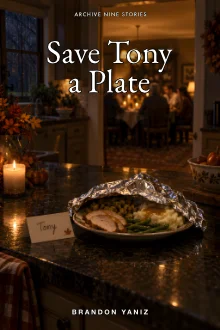
Mom always gave Uncle Tony the good pieces of turkey, which was one of those small family facts I had never thought about until I saw her doing it for a dead man. She went for the dark meat first, then found a strip of skin that had stayed crisp instead of going soft under the foil, spooned stuffing from the edge of the pan where it had soaked up most of the butter, and pushed the mashed potatoes over so she could fit some green-bean casserole beside them. Tony would have complained there was too much food. Mom would have told him he could throw away whatever he did not want, which he never did, and the two of them would have had the same argument they had been having since I was a kid. Dad was beside her drying dishes, Melissa had taken over scraping plates because Mom hated hearing silverware against china, and Jeremy had his phone propped against the sugar bowl showing Dad the television he wanted to buy, something he had already managed to work into dinner twice. The football game was loud enough in the living room that every few seconds a crowd we could not see reacted to something none of us were watching, and the kitchen had that overheated Thanksgiving smell of turkey, sage, browned butter, old coffee, pumpkin pie, and too much cinnamon from the candle Mom always insisted made the house smell festive even after the food had already done the job.
I watched her tear off a sheet of foil and thought maybe this was something they did now. It would have been strange, but we had spent the last year getting used to strange things around Tony. Mom still kept his number near the top of her favorites. She called it Christmas morning and then claimed she had hit the wrong name, although she had stared at the phone for a long time before hanging up. Dad sometimes started telling one of Tony's stories and lost interest before reaching the end. Once, at Mom's birthday, Melissa set an extra fork at the table and quietly put it back in the drawer before anyone else noticed. Grief had made all of us a little stupid in ways we had agreed not to comment on, and because I lived closer to the city and only saw them every couple of weeks, there were probably things they did when I was not around. Saving Tony a plate would have been sad, but sadness at least fit the year we had just had, and I could understand Mom putting food in the refrigerator for a brother she still had not learned how to stop expecting.
Then she said Tony would be starving by the time he got there. Dad said the rental counter would probably be a nightmare that late, Melissa reminded him Tony was staying through the weekend anyway, and Mom laughed because after three days of canceled flights there was no chance Tony would land, pick up a car, and then behave like a normal person. He would take every delay personally until he got through their front door. I kept waiting for somebody to look at me, but Jeremy was still talking about screen sizes, Melissa was stacking plates, Dad had moved on to drying serving spoons, and Mom folded the foil beneath the plate, tucked the sides in, and opened the refrigerator.
I asked what she was doing. She looked at the plate, then at me, and said she was putting food away. I asked if it was for Tony. Her yes came back puzzled, not irritated yet, just confused about why I needed her to explain something I was already watching, and that was the first moment I thought they might be making a joke. Not a good one. Not even one I understood. Maybe some anniversary thing they had come up with because they all saw each other constantly and I did not, another little family decision that had somehow happened without me. The idea annoyed me before it scared me. Tony's death had ruined the previous Thanksgiving, then Christmas, then New Year's, then every gathering afterward in a quieter way. Mom could barely say his name for months. Dad went strange whenever anyone mentioned airports. Melissa had cried in my car after the funeral until the windows fogged from the heat because she kept saying she was cold. Now Mom was saving him turkey as though he had merely missed dinner.
I told her it was cruel, and that stopped the room more effectively than shouting would have. Mom left the refrigerator door open and stared at me. Dad lowered the dish towel. Melissa still had a plate in one hand. Jeremy finally looked away from his phone. Mom wanted to know what I meant, and there should have been something in her face, embarrassment or annoyance or some sign that she understood why I was upset and thought I was overreacting. Instead she looked like I had accused her of hurting someone and she honestly had no idea who.
They started explaining Tony's trip to me because, from their side of the room, that must have seemed like the missing piece. His flights had been delayed and canceled for days. He had spent another night near the airport, finally found a seat that afternoon, and was supposed to land late. He would rent a car, drive to the house, and stay through the weekend. Mom had talked to him earlier. Dad had talked to him the night before. Melissa said Tony had joked about Jeremy eating all the stuffing before he got there, which Jeremy objected to because apparently that was the part of the conversation worth correcting. I did not ask to see a message. I should have, but at the time it felt insulting. They were my family. I was not going to demand Mom prove she had spoken to her own brother, and besides, they were not trying to convince me. Nobody reached for a phone. Nobody offered evidence. Tony being alive was as ordinary to them as the pie on the counter.
Mom said something about his connection through Atlanta, and suddenly she was on the phone with him a year earlier, standing in almost the same place with her hip against the counter while she told him to give up and come the next day. Tony had refused. Of course he had. He had spent that entire week treating the airline like an enemy that could be beaten through persistence, and every cancellation only made him more determined to find another route. When he finally landed after ten on Thanksgiving night, he rented a car because waiting until morning would have meant admitting the airline had won something. At eleven thirty-eight, a twenty-four-year-old driving home from a friend's Thanksgiving gathering crossed into Tony's lane and hit him head-on. The guy had been drinking all day. Later we found out he was almost three times over the legal limit, which became one of those facts everyone repeated because the number gave us something solid to hate. Mom called me at twelve fourteen, and I was sitting on the edge of my bed with one sock on, one foot on the floor, the other bare, phone in my hand, listening to her say my name three times because she could not get any further.
Someone said my name again, and the kitchen came back wrong. Mom had closed the refrigerator. Dad was closer to her than he had been before. Melissa was watching me, and Jeremy had put his phone facedown on the island. I had missed something. Melissa asked if I was listening, and I told them Tony died last Thanksgiving.
It came out quieter than I intended, and for a second I wanted to try again only because the sentence sounded too small for what it meant. Tony had been dead for a year. We had buried him. There had been a funeral and police reports and court dates and the whole miserable rearrangement of a family around an empty chair, and I had just said it in the same voice I might have used to tell them we were out of coffee. Mom looked hurt. Dad looked confused. Melissa looked angry almost immediately, which made more sense to me than the other two, while Jeremy watched me with that careful expression he got when somebody else was becoming difficult. I had seen it with waiters, contractors, customer-service people, Mom once when she was furious with a cable company. He never looked smug. That would have been easier. He looked patient.
I told them again. Tony died on the way from the airport. A drunk driver crossed the center line. Mom called me after midnight. I waited for something to happen in their faces, some break in the confusion, some sign that they remembered and hated me for making them remember, but Mom told me Tony was alive, Dad backed her up before she finished, and Melissa wanted me to stop upsetting her. At first they were gentle, which I hated. If they had yelled, I could have yelled back and at least we would have been participating in the same argument. Instead they treated me as though I had confused Tony with another relative or mixed up two Thanksgivings.
I tried to make Mom remember the phone call. I told her about sitting on the bed. I told her about the sock because that detail had to mean something. Nobody invents one sock. If I were making up a memory of learning my uncle was dead, surely I would have given myself something better than sitting half dressed on the edge of a mattress. Mom stopped looking at me, Dad moved closer to her, and Melissa told me to knock it off. I knew how bad this looked. I knew that while I was trying to make Mom remember one of the worst nights of her life, what they saw was me describing her brother's death in detail after she had asked me to stop. I also knew Tony was dead, and those two things had no business existing together.
So I told them about the funeral. The chapel had only been available on a Tuesday. Dad forgot his reading glasses and spent half the service touching every pocket in his suit even after all of us knew they were not there. Noah started running a fever before the burial, and Jeremy took him home in Melissa's car while she stayed with us. Sleet had been tapping against my windshield afterward, hard enough that the wipers kept dragging it into gray streaks, while Melissa sat in the passenger seat with the heat turned so high I eventually opened my coat and she still kept rubbing her hands together and saying she was cold. She had used every tissue in my console, then started wiping her face with the sleeve of her coat, which was one of those things I did not mention because telling someone how bad they looked while they were grieving seemed unnecessarily cruel. She said she kept expecting Tony to walk through the door complaining about the airline, laughed once when she said it, then covered her mouth like she had done something obscene. I reached across the console and took her hand. Her fingers were cold.
Someone was saying my name, and when I looked up Melissa had put the plate down. I had no idea when. She was staring at me differently now, not angry in the same way, more like I had told a story about the two of us that embarrassed her. She said that never happened. For a few seconds I could still feel her hand in mine, and that was worse than Tony being alive because Tony was not in the room. Melissa was standing six feet away from me telling me that an afternoon I could still smell and touch had never happened, and she looked offended that I would claim it had. I wanted to ask whether she remembered the sleet, then realized how stupid that was. If she did not remember the funeral, why would she remember the weather after it?
I started running through the year instead. Christmas without Tony. Dad getting quiet around the court dates. Mom finding one of Tony's old voicemails and sitting at the kitchen table crying while it played. His birthday. The first cookout where nobody knew who was supposed to work the grill because Tony always did it whether anyone asked him to or not. Every memory felt normal, which was what made the whole thing worse. If one of them had felt different, softer around the edges or dreamlike or somehow marked as false, I could have thrown it away. They did not. They sat in my head beside every other memory I trusted.
I pulled out my phone because memory had stopped being enough. The date was right. Thanksgiving, one year after Tony died. I searched his name and found no obituary, changed the search because maybe I had remembered the funeral home wrong, then searched the highway and the date of the crash. The first time I typed the highway number wrong because my thumb kept catching the wrong key. I fixed it. Nothing. Melissa asked what I was doing and I ignored her. I searched for the driver because I knew his name, had hated his name for a year, could still see the photograph they used in the news story, short hair and a face that looked younger than twenty-four. Dad had refused to look at it. Mom had asked once whether he had kids and then got mad at herself for caring. I searched again and still found nothing.
My photographs were worse. No funeral home. No church. No cemetery under a gray sky. I scrolled too quickly, went past Christmas, backed up, checked the dates again. There were pictures of food, a screenshot I had forgotten saving, something from work, and Tony himself from months before he died, standing beside a grill he had rebuilt and looking unnecessarily proud of it. My messages still had him too, birthday wishes, a joke about Mom's cooking, a picture of the grill. Nothing about the accident. Nothing from Melissa after the funeral. Nothing from Mom at three in the morning because she could not sleep. I could not find a dead man I had spent a year grieving, and the kitchen had become unbearably hot around me while I searched. The dishwasher was still running although the cleanup had stopped. Someone had left the refrigerator open again, and the motor kept humming harder as if it were trying to compensate. The cinnamon candle smelled too sweet. Turkey fat sat cold on one of the serving platters Dad had never finished drying.
Jeremy asked whether I had been sleeping, which was exactly the kind of question Jeremy asked. Not because it was necessarily a bad question. That was part of the problem. Jeremy could ask something completely reasonable and still make me want to throw him through a wall. He asked about work, stress, sleep, whether I had taken anything. I told him I was fine, and he looked at Mom when I said it. That tiny movement bothered me more than the questions. I asked him not to do that. He wanted to know what he had done. I told him he knew. He did not, or he pretended not to, and the possibility that he genuinely did not know only made me angrier because then I was the one manufacturing something out of a glance.
Jeremy went through what I had been saying. He did not put it cruelly, which would have helped me. He said I had come into the kitchen, told Mom her brother was dead, described a funeral Melissa said never happened, and kept going after everyone asked me to stop. From his side, it sounded terrible, and I knew that. I hated him for making me hear it. He and Melissa lived three houses from Mom and Dad, which meant Jeremy was always there. A leak under the sink, a doctor's appointment, a cabinet Dad could not move, Jeremy either handled it or knew who did. I lived fifty minutes away because of work, which I had never considered particularly far until Jeremy moved three houses down and made fifty minutes feel like another state. Most problems reached me after they were solved. That was not my fault, or at least that was what I always told myself. Nobody called me before Jeremy because Jeremy was right there. It made sense. I knew it made sense. I still resented the hell out of him for it.
Now Mom was looking at him instead of me, and I watched that happen until something in my head locked onto it. Jeremy asked another question. Dad answered him. Melissa said something I missed because I was looking at Mom. Jeremy leaned closer to her, not much, just enough that he became the person physically nearest to her, and suddenly all the old irritation I had carried around him had somewhere to go. This was what he did. At least that was what I thought. He stepped into a problem until everyone started treating him like part of the solution, and once that happened, disagreeing with Jeremy meant disagreeing with everybody who had already accepted his help.
I told him to stop talking for them. Melissa said he was not, and Jeremy answered before she finished. I looked at her because there it was, exactly what I meant, except she stared back at me like she had no idea what I thought I had proved. I told them Jeremy was doing something, and the sentence sounded bad as soon as it left my mouth because I did not have an answer to the obvious question. Doing what? Maybe he had been working on Mom and Dad for months. Maybe he knew something. Maybe Melissa was involved. I knew each idea became less believable the more I added, but the alternative was that three people had independently forgotten a death and one man I already distrusted happened to be standing in the middle of them telling everyone I needed sleep.
Jeremy finally asked how I thought he could convince Mom, Dad, and Melissa that a dead man was alive. I did not know. Dad told me to leave him out of it, and Melissa had had enough. She started listing everything Jeremy had done lately, the leak, the furnace appointment, helping Dad move a cabinet, driving Mom somewhere when Dad could not. I tried to tell her living fifty minutes away did not mean I had abandoned them, which only made her angrier because apparently I had missed the point. She was not accusing me of abandonment. She was accusing me of showing up after everything happened, hearing half the story, then acting like I understood it better than the people who had been there.
I wanted to argue, and I had plenty to work with. Nobody had called me about the furnace. Nobody asked me to move the cabinet. I worked in the city. I could not appear at Mom's house every time a sink leaked. Jeremy lived three houses away, so of course he was there first, and that did not mean he cared more or that I cared less. I thought all of that almost at once, and most of it came out in some form, but the furnace appointment bothered me because I genuinely had not known about it. I immediately decided nobody had told me, which was probably true and also conveniently kept the whole thing from being my fault. Jeremy had been there. I had not. I hated how easily Melissa could make those facts sound connected.
After that Jeremy started answering questions I was asking other people. When I tried to get Mom to tell me what she remembered, he said she did not have to keep doing this. When I turned toward Melissa, he said we were all upset and should stop for a while. We. He had become part of the family argument so completely that he was now speaking for the group, and I told Melissa this was exactly what I meant. He stepped into everything. He made himself necessary and then acted like the rest of us were unreasonable for noticing. That was not quite what I said. What came out was messier, and somewhere in the middle of it I told her she did not see what he was doing.
Her face changed, and I knew immediately what she heard. Not that Jeremy was manipulative. That she was stupid. I tried to fix it, which made it worse because she had been married to him for years, lived with him, had children with him, and I saw him at holidays and occasional weekends and apparently believed I understood him better than she did. I wanted to tell her that was not what I meant, although some part of me knew it was at least partly what I meant, and by then nobody was talking about Tony.
Mom had both hands on the counter. Dad was beside her. Melissa and Jeremy had moved closer together without either of them deciding to. The plate Mom had made for Tony was somewhere behind them in the refrigerator, wrapped in foil and waiting, and that was when the obituary came back to me. Not Tony's death first. Mom's hand. Her thumbnail. The funeral home had drafted the obituary from whatever information the family gave them, and nobody looked closely enough before it went online. The second paragraph said Tony had been adopted.
I said it, and Mom stopped moving. Her right hand was flat against the counter, and I watched her fingers pull slightly inward while nobody else reacted because the adoption itself did not mean anything to them yet. Then Mom asked how I knew, and her voice had changed. That was the first thing all night that felt like proof. I could barely get the explanation out fast enough. The funeral home put it in the obituary. Mom had been furious when she read it. She hated the wording because it made Tony sound like he belonged to the family differently, like being adopted meant there had to be an explanation attached to the word brother. I told her what she had said, that they made it sound like he had to qualify as her brother.
Mom's face had gone pale. Dad looked at her. Melissa looked at her. Even Jeremy stopped talking. Mom asked again who had told me Tony was adopted, and I told her nobody had, that I learned it after he died. She pressed both hands harder against the counter and said Tony was her brother, he had always been her brother, almost the same words she had used when she read the obituary the first time. Relief hit me so fast I nearly laughed. There it was. I was not crazy. I had known something I could not know, and Mom knew it too. She looked frightened now, genuinely frightened, and I waited for her to say what I needed her to say.
Jeremy got there first. Maybe I had seen paperwork. Maybe something came up online. Maybe Mom had mentioned it years ago and I forgot. He was not even insisting on one explanation. He was offering possibilities, which somehow made it stronger because nobody had to prove any of them. They only had to be more believable than a dead man coming back to life. Dad visibly relaxed, and for half a second I hated him for it before I understood why. Jeremy had handed him a world where his son was confused instead of a world where his brother-in-law had died a year ago and somehow nobody remembered. Of course he wanted that world. Melissa wanted it too. Mom looked down at the counter.
I told Jeremy he was lying. He asked about what. Everything. The papers. Mom telling me. The way he was standing there making me sound insane. He said he was not making me sound like anything. I told him that was bullshit. Dad said my name, but I kept going because Jeremy was doing exactly what he always did. He never had to accuse anyone. He just stayed calm until the other person looked worse. Jeremy pointed out that Mom was already scared before he said anything, so was Melissa, and all he had done was ask me to stop. I could hear how loud I had become, but hearing it did not make me quieter.
Melissa said this was what I always did with Jeremy. Every favor became a scheme. Every time he helped Mom or Dad, I found some reason to resent it. Then I came home, criticized whatever had happened while I was gone, and left again before the next problem came up. I told her that was unfair, and she asked which part, which opened something in me because I had answers. Too many answers. Nobody called me about the furnace. Nobody asked me to move the cabinet. I worked in the city. I could not appear at Mom's house every time a sink leaked. Jeremy lived three houses away, so naturally he was there first, and that did not mean he cared more or that I cared less or that any of this had anything to do with Tony. Somewhere in there I heard myself trying to win an argument I had not known we were having until ten minutes earlier.
Jeremy stepped closer. He did not touch me, which became important afterward, but at the time all I noticed was coffee on his breath and the fact that he had moved close enough to speak quietly without anyone else missing a word. He said I had told Mom her living brother was dead, made Melissa listen to a funeral she said never happened, dragged out something private about Tony because nobody believed me, then blamed him when that still did not work. I wanted him to shut up. I could see a smear of dried gravy near the edge of the island behind his elbow and had no idea how long it had been there. Jeremy looked tired now, not smug or victorious, and that bothered me more because I had spent half the night needing him to look like the person I believed he was. Instead he looked like a man who was exhausted by me, and then he said Tony showed up for the family more than I did.
I hit him.
There was no decision between the sentence and my hand moving. One moment he was standing there, coffee on his breath, and the next I felt his mouth against my knuckles and heard the chair legs scrape hard across the floor as he went sideways. Melissa screamed, and the room came apart around me. She dropped beside him. Dad got between us. Mom backed into the counter. Jeremy had blood on his lower lip and looked more surprised than hurt. Melissa kept saying he had not touched me, and I knew that. Dad pointed toward the door, but I looked at Mom because the adoption was still true. Nothing that happened with Jeremy changed that. She knew I should not know. Tony's plate was in the refrigerator behind her, wrapped in foil and waiting for a man I remembered burying, and I said Mom because I still wanted one thing from her before I left. She told me to go home. I tried again. She told me to go.
I made it to the driveway before realizing I had left my coat hanging by the back door. The cold went straight through my shirt, sharp enough that my shoulders pulled up around my neck, and I almost turned around until I pictured opening the kitchen door and seeing all of them looking at me again. Mom's blue coat was hanging beside mine, the same one she wore to Tony's funeral, and that thought was enough to keep me moving. My hand started hurting before I reached the end of the street. I had not hit Jeremy particularly well. My knuckles were already swelling, and gripping the steering wheel pulled something along the side of my wrist. Every few minutes I loosened my fingers and flexed them, then grabbed the wheel again because the roads were mostly empty and I had started driving faster than I realized.
My shirt smelled like Thanksgiving, turkey and sage and cinnamon from Mom's stupid candle, and Jeremy's face kept coming back whenever I stopped paying attention to the road. Not angry. Surprised. Then Melissa on the floor beside him. That was what they would remember. Not Mom's hand on the counter when I said adopted. Not the way she asked how I knew. They would remember me punching Jeremy because nobody agreed that a living man was dead. At a red light I sat too long after it changed and somebody behind me leaned on the horn. I lifted one hand in apology and drove through the intersection without remembering whether I had checked the cross traffic.
Jeremy was an asshole, and he had also been right about some things, and I did not want both of those ideas in my head at once because letting the second one stay there felt like giving up the first. The funeral still happened. I knew it happened. Wet coats packed into the chapel, Dad checking his pockets for glasses he did not have, Jeremy carrying Noah out while the kid slept against his shoulder, Melissa in my car afterward with both hands around one of mine because she could not get warm. People did not invent that much. I believed that for several miles, then stopped knowing why. What was a false memory supposed to feel like? Something blurry? Obviously wrong? A dream you could recognize if you stared at it long enough? I had no idea, and maybe that was exactly the problem. Maybe a false memory felt exactly like every other memory until somebody proved it was false.
That thought made my stomach drop hard enough that I pulled into the parking lot of a closed pharmacy and shut off the engine. The place was almost completely empty. One cart sat crooked in the return near the entrance. The pharmacy sign was dark except for one red letter that stayed lit for no reason I could understand, and a security light above the doors made the wet pavement shine. After I turned off the car, the windows slowly fogged from my breath, the engine ticked as it cooled, and my swollen hand throbbed against my leg while I opened Tony's contact and stared at his number.
I could call him. That was the stupid part. I had spent an hour arguing, searching, accusing people, digging up a family secret, and punching my brother-in-law when the answer had been sitting in my phone the entire time. I pictured Tony answering from the rental-car counter, exhausted and annoyed after three days of airports, complaining about the airline before I could get a word in, telling me they had probably sent his luggage somewhere useless, then calling me Bri even though I had told him not to since I was fourteen. For a moment I wanted that more than I wanted to be right. I wanted Tony alive, and wanting it that badly made everything else harder because if he answered, Melissa had never cried in my car, Mom had never called me after midnight, there had been no funeral, no cemetery, no court dates, no year of watching everyone figure out how to talk around Tony's absence. I had spent an entire year remembering something that did not happen, and if my mind could do that, I had no idea where the problem ended. Maybe Tony was only the first thing anyone had contradicted.
My thumb hovered over the call button while I told myself I needed another minute, which was a lie I recognized even as I used it. I did not need another minute. I needed the answer to become less frightening before I asked the question. The screen dimmed under my thumb, and I still did not press it. I put the phone facedown on the passenger seat and sat there long enough for the windshield to fog completely before I started the car again and drove home.
By the time I reached my apartment, my knuckles had swollen enough that bending my fingers hurt. I left the lights off and went straight to the sink, where city light came through the blinds in narrow strips, enough to show the glass I had left beside the faucet that morning and a stack of mail I had been ignoring for three days. I turned on the cold water and put my hand under it. The cold hurt at first, then helped, and while I watched water run around the swelling I let myself picture Tony really being at the airport, alive and irritated, pulling a suitcase behind him while I stood in my dark kitchen because I had been too afraid to hear his voice. I almost reached toward the phone.
It rang before I touched it.
Mom's name filled the screen, and my hand stayed under the water for a second before I answered. She was already crying, and the sound of it took me back so completely that the apartment disappeared. I was sitting on the edge of my bed again with one sock on, phone pressed to my ear, waiting for her to get through my name while the same silence stretched between us. The faucet kept running over my swollen hand as she tried once, stopped, breathed, and tried again, and by the time she said there had been an accident I already knew what came next. Tony was dead. After that she could not get anything else out, and I stood in the dark listening to my mother cry into the phone while cold water ran over the hand I had used to hit Jeremy, hearing a call I had already lived through once.